Order for Rs. 1500 or more and get 10% Off. No Coupon Code Required.

How to Check if Honey is Pure or Adulterated – The Complete Guide with Video
This article has everything you need to know about checking...
Read More


WELCOME TO BHARAT HONEY
At Bharat Honey, we have been bringing pure, natural honey to customers for nearly four decades. Our journey began with traditional honey hunters, and today we source honey directly from trusted beekeepers and honey collectors across India, without middlemen.
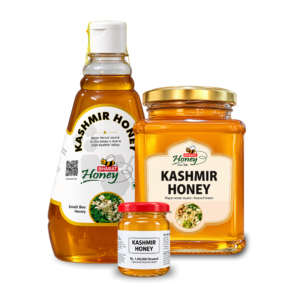
We believe every honey has its own natural character, influenced by the flowers, region and season in which it is collected. From Kashmir Acacia and Jamun to Sidr, Ajwain, Litchi and Wild Forest Honey, we offer a wide range of distinctive honey varieties.
Our honey is carefully sourced, minimally filtered and packed without excessive heating or ultrafiltration to preserve its natural taste, aroma and character. With AGMARK Grade A certification and advanced purity testing, including NMR and LC-HRMS, we remain committed to delivering authentic honey you can trust.
We stand behind the authenticity of our honey with a publicly stated challenge, subject to verification and published terms.


Nothing added. Carefully packed.
Distinct flavours from nature.
NMR & LC-HRMS analysis.
Direct from Beekeepers & Honey Hunters
Our commitment to authenticity.
Free shipping above ₹550.


The Bharat Honey team travels across India during different flowering seasons to source natural honey directly from traditional honey hunters and experienced beekeepers.
We visit honey-producing regions to understand the floral sources, harvesting practices and quality of honey right at its origin.
Our honey is collected in two ways:
1. Wild Honey: Collected from natural beehives and honeycombs in forests by experienced traditional honey hunters. We also offer fresh natural honeycomb.
2. Apiary Honey: Collected from beehives managed by experienced beekeepers. The beehives are placed near different flowering regions to produce honey with distinct natural flavours, colours and aromas.
At Bharat Honey, we focus on directly sourced honey, careful handling and minimal processing to preserve its natural characteristics.
Watch our journey and learn how Bharat Honey started:
The Story of Bharat Honey: Hindi Video | English Video
The taste, aroma, colour and texture of natural honey vary depending on the flowers from which honeybees collect nectar.
Honeybees commonly forage within 1–2 km of their hives, although they can travel much farther. When nectar comes predominantly from one floral source, the honey is called Monofloral Honey. When nectar comes from several types of flowers, it is called Multifloral Honey.
India’s diverse climate and flowering seasons allow us to source different natural honey varieties, including Sidr Honey, Jamun Honey, Eucalyptus Honey, Ajwain Honey, Litchi Honey and Mustard Honey.
Each variety has its own natural taste, aroma, colour and characteristics.
At Bharat Honey, we follow five important steps to maintain honey purity, quality and authenticity.
1. Direct Sourcing Without Middlemen
We source raw honey directly from beekeepers and traditional honey hunters during flowering seasons, helping us understand its origin and quality.
2. Advanced Laboratory Testing
We use advanced laboratory methods, including NMR and LC-HRMS testing at Intertek Germany, to assess honey authenticity and screen for indicators of certain types of sugar syrup adulteration. Laboratory results are evaluated alongside sourcing information and other quality checks.
View Bharat Honey Laboratory Reports.
3. Pollen Analysis for Floral Identification
We use microscopic pollen analysis to help identify honey’s floral origin and support the classification of varieties such as Jamun Honey as monofloral honey.
4. Quality Control and Testing Standards
We assess honey quality using relevant parameters, including moisture, sugar composition, HMF and diastase activity, as part of our quality-control process.
5. ₹1,00,000 Honey Purity Challenge
We offer ₹1,00,000 if adulteration is scientifically proven in an eligible Bharat Honey bottle, subject to our challenge terms.
Read Our ₹1,00,000 Honey Purity Challenge.
Can Home Tests Determine Honey Purity?
No. Water tests, thumb tests, flame tests and thickness cannot reliably establish honey purity. Scientific laboratory analysis is the appropriate approach.
Learn more: How to Check if Honey Is Pure or Adulterated.
Watch our video: How to Check the Purity of Honey.
1. Direct Sourcing – No Middlemen
We source honey directly from beekeepers and traditional honey hunters across different regions of India, without depending on middlemen. This helps us understand the floral source, harvesting season and quality of honey right from its origin.
2. Purity and Minimal Processing
Bharat Honey offers pure, natural, raw honey without added sugar syrups, artificial colours, flavours or preservatives. We avoid excessive heating and ultrafiltration to preserve natural enzymes, pollen, aroma and other naturally occurring compounds. Excessive heating can reduce enzyme activity and increase HMF levels.
3. Natural Floral Varieties
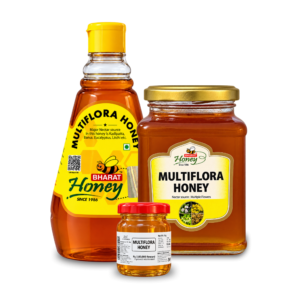
We offer varieties including Jamun, Kashmir Acacia, Sidr, Ajwain , Multiflora Honey and many more. Each has its own natural colour, taste and aroma. We also use pollen analysis to help verify the floral origins of selected varieties.
4. Natural Characteristics
Our honey may naturally vary in colour, flavour, thickness and texture depending on its floral source, harvesting season and storage conditions.
5. Natural Crystallisation
Our honey may crystallise naturally depending on its floral source, sugar composition and storage temperature. We do not add anti-crystallisation chemicals. Crystallisation is natural but does not, by itself, prove purity.
Our Difference: Direct sourcing, no additives, minimal processing and respect for honey’s natural characteristics. We prioritise preserving honey’s original qualities over achieving a uniform commercial appearance.
Yes. Honey can naturally crystallise or become solid over time, depending on its floral source, natural sugar composition and storage temperature.
Crystallisation is a natural property of honey and does not, by itself, establish purity or adulteration. Some honey varieties crystallise faster than others.
To make crystallised honey liquid again, place the tightly closed jar in warm water (around 40°C) and allow it to dissolve gradually. Avoid boiling water or direct heating.
Learn more: Crystallisation of Honey – Hindi Video | English Video
At Bharat Honey, our four decades of experience have taught us that honey quality begins inside the beehive. When honey is harvested after proper ripening, it naturally contains less moisture and generally requires minimal processing.
We follow a simple process to preserve honey’s natural characteristics:
1. Natural Settling: Freshly harvested honey is allowed to stand in containers so that wax particles, bee debris and other visible impurities can separate naturally. We carefully collect the clearer honey, leaving the settled impurities behind.
2. Gentle Warming and Filtration: The honey is transported to our hygienic facility, where it is gently warmed when necessary and strained to remove remaining visible impurities without ultrafiltration.
3. Temperature Control: Throughout our handling process, we maintain honey temperatures below 45°C, avoiding excessive heating and pasteurisation.
This minimal-processing approach helps retain the honey’s natural taste, aroma and characteristics.
Our principle is simple: Preserve honey as close to its natural state as possible.
Genuine, natural honey is seasonal, produced across scattered regions and available in limited quantities. This raises a serious question: How can some brands consistently sell large quantities of honey at exceptionally low prices?
1. Natural Honey Has a Cost
Honey production depends on flowering seasons, weather and nectar availability. Different floral varieties have different sourcing costs, and some are available only for a short period each year.
2. The Risk of Sugar Syrup Adulteration
Honey adulteration with undeclared sugar syrups is a documented industry concern. In 2020, a Centre for Science and Environment (CSE) investigation reported that 17 of the 22 honey samples examined failed advanced authenticity tests.
These findings highlighted concerns about honey authenticity but should not be generalised to every commercial honey brand or the entire market.
3. Genuine Honey vs Mass Production
Large brands can reduce costs through bulk purchasing and blending. However, consistently supplying natural honey at extremely low prices deserves scrutiny, particularly when genuine honey production is seasonal and geographically scattered.
4. Why Bharat Honey Costs More
We directly source different floral varieties from beekeepers and traditional honey hunters, select naturally ripened honey, use minimal processing and invest in advanced authenticity testing, including NMR and LC-HRMS.
Our View: When honey is sold at prices that appear inconsistent with genuine sourcing and production costs, consumers have every reason to question its authenticity and demand independent laboratory evidence.
This article has everything you need to know about checking...
Read MoreIs Your Honey Crystallized? Here’s What It Really Means If...
Read MoreA First of Its Kind in Hyderabad, Perhaps in All...
Read MoreFloral honey varieties (Monofloral honey) is a type of honey, made from...
Read MoreA 360 virtual tour of BharatHoney is live now on Google! You can interact for an immersive experience, and you can also visit our BharatHoney experience center.